What Teachers Wish Parents Knew About Language Development in Young Learners
Language development is the way young children learn to understand and use sounds, words, sentences, and conversation. Teachers wish parents knew that it grows through everyday, responsive interaction—not through drills alone—and that children develop at different rates. The National Institute on Deafness and Other Communication Disorders notes that many children say their first word around their first birthday, while the American Speech-Language-Hearing Association emphasizes that milestones are guides, not diagnostic tests. Understanding how language develops, how home and school can support it, and when to seek guidance helps families nurture communication in every language a child uses.
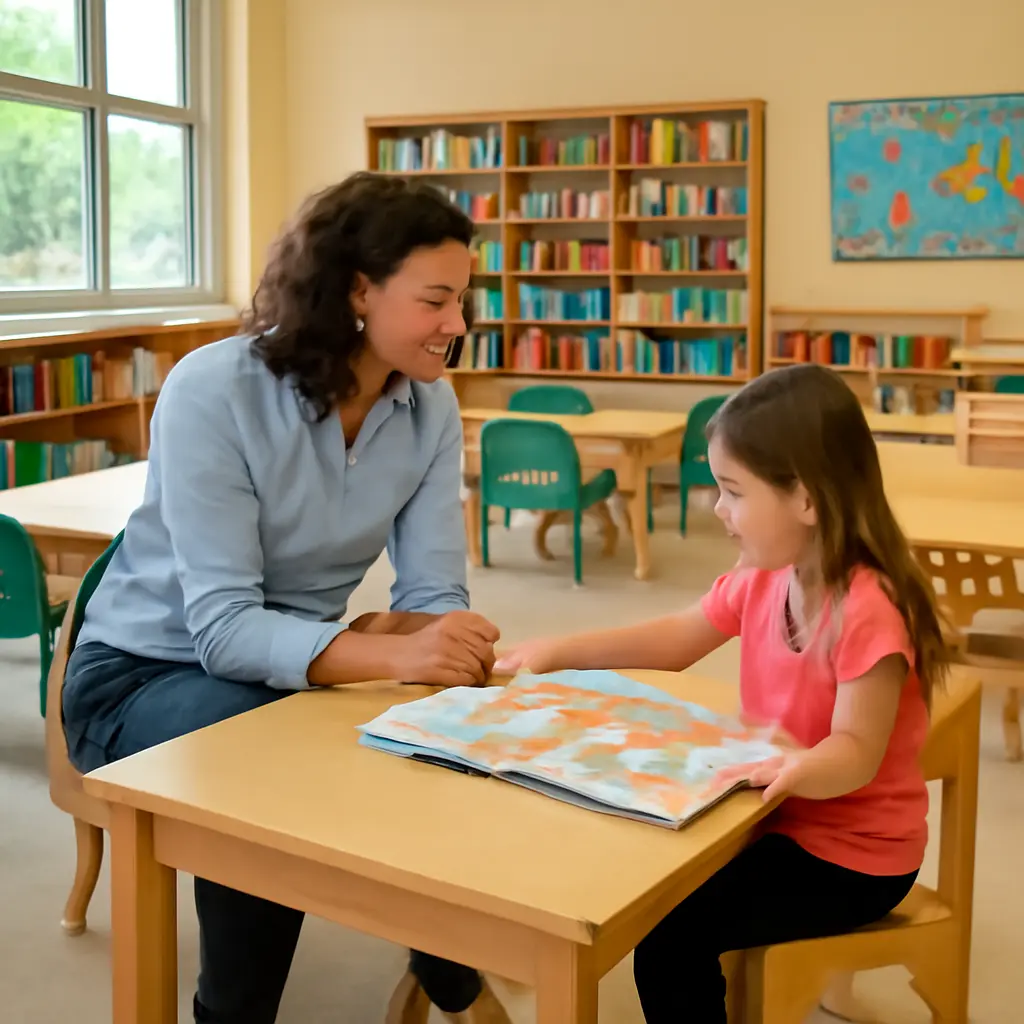
Responsive conversation supports language development in young learners
Language development refers to children’s growing ability to comprehend and communicate through speech, sign, and other language systems. The National Institute on Deafness and Other Communication Disorders describes early communication as a progression from sounds and gestures to words and increasingly complex language. Teachers commonly see receptive language—what a child understands—and expressive language—what the child communicates—as related but distinct areas. A child may understand much more than they can yet say.
Children learn language in relationships. When an adult notices a child’s focus, responds, and adds a little language, the exchange gives the child a reason to listen and communicate. Harvard University’s Center on the Developing Child calls these responsive exchanges “serve and return.” The term describes a back-and-forth interaction, not a requirement that parents constantly quiz or entertain their children.
Receptive and expressive language grow together
Receptive language includes understanding familiar words, directions, questions, and stories. Expressive language includes communicating needs and ideas through words, signs, gestures, or combinations of these. A toddler who follows a familiar instruction but uses few spoken words, for example, may show stronger understanding than spoken expression. Teachers observe both dimensions, along with gestures, attention, and social interaction, rather than judging development from vocabulary alone.
Back-and-forth interaction gives words meaning
A responsive exchange follows the child’s attention and leaves room for a reply. If a child points to a bus, a parent might say, “Yes, a big blue bus. It’s stopping.” The adult labels and expands the child’s idea without demanding repetition. A landmark study by Gilkerson and colleagues, published in 2017 in the journal JAMA Pediatrics, found that adult-child conversational turns were associated with children’s language skills. The study supports the value of interaction, while its findings should not be treated as proof that a single number of daily turns guarantees a particular outcome.
Play, routines, and books create everyday practice
Play and ordinary routines offer meaningful opportunities to hear and use language. Cooking, getting dressed, building with blocks, and pretend play all invite children to name objects, describe actions, take turns, and tell what might happen next. Shared reading adds exposure to stories and new vocabulary. A 2019 meta-analysis by Dowdall and colleagues in Child Development found that shared picture-book reading interventions can improve young children’s language, with outcomes influenced by how adults engage children during reading. Families do not need special materials: talking about pictures, pausing for a child’s response, and rereading a favorite book are useful practices.
Language milestones guide observation, not diagnosis
Language milestones are skills many children develop within an approximate age range. The Centers for Disease Control and Prevention (CDC) explains that its developmental milestones describe skills at which at least 75% of children are expected to be able by a given age. They are intended to help families and professionals monitor development, not to replace standardized screening or professional assessment. A milestone checklist can prompt a conversation; it cannot determine on its own whether a child has a language disorder.
Milestones vary across children and across skills
Children do not acquire every skill on the same timetable. One child may use many words but still be learning to follow longer directions; another may communicate effectively with gestures while spoken words are emerging. The American Speech-Language-Hearing Association advises families to consider a child’s full communication profile and consult a speech-language pathologist when they have concerns. Teachers can share classroom observations, but they do not diagnose language disorders.
A missed milestone is a reason to ask, not to wait in silence
A difference from a milestone range does not establish a diagnosis, but it is reasonable to discuss persistent concerns with a pediatrician or speech-language pathologist. The CDC recommends developmental monitoring and screening at specific well-child visits, and additional screening whenever a parent or professional has a concern. Families should seek prompt advice if a child loses skills they previously used, since regression warrants professional attention.
In the United States, the Individuals with Disabilities Education Act provides for early-intervention services for eligible infants and toddlers and special education services for eligible preschool-age children. Families can contact their state or local early-intervention program to ask about an evaluation; eligibility and service pathways vary by location. A teacher’s notes about what a child understands, says, signs, and does in different settings can make those conversations more informative.
Hearing is part of the language picture
Hearing access helps children perceive the sounds and patterns of language. A child who often does not respond to speech, asks for repetition, or seems to hear some sounds but not others may benefit from a hearing check, even if they passed newborn screening. The National Institute on Deafness and Other Communication Disorders notes that hearing loss can affect speech and language development and encourages families to discuss concerns with a health professional. Hearing assessment is one part of understanding a child’s communication, not an assumption about the cause of a delay.
Home languages strengthen, rather than hinder, communication
A multilingual child learns language through exposure to and use of more than one language. The American Speech-Language-Hearing Association states that learning multiple languages does not cause a language disorder. Teachers therefore encourage parents to speak, read, sing, and play in the language or languages they know best. Rich, comfortable interaction is more valuable than switching to a language in which a parent feels less able to communicate naturally.
Vocabulary may be distributed across languages
A multilingual child may know a word in one language and a different word in another. Looking only at vocabulary in the school language can give an incomplete picture of what the child knows. Families and educators can share examples of words, phrases, and communication skills across the child’s languages. The National Academies of Sciences, Engineering, and Medicine has emphasized that children’s language experiences and abilities should be understood in the context of their exposure and opportunities to use each language.
Mixing languages is a normal communication strategy
Children may combine words from different languages in a sentence, a practice often called code-mixing or code-switching. It can reflect a child’s available vocabulary and the language patterns of people around them; by itself, it is not evidence of confusion or disorder. Adults can respond to the meaning, model a phrase in the language they are using, and keep the conversation going rather than correcting every mixed-language sentence.
Language concerns should be considered across languages
When a child has ongoing difficulty communicating, professionals should consider skills and learning opportunities across the child’s languages, using appropriate assessment methods and interpreters when needed. A challenge limited to a newer or less-exposed language may reflect experience; difficulties across languages may call for closer assessment. Families can help by describing when each language is used and how the child communicates with different people. Maintaining a home language also supports connection with family and community.
Families and teachers can work together to support communication
Teachers see children communicate with peers and adults in classroom routines, while families know how they communicate at home and in their community. Sharing observations across settings helps adults notice strengths, identify questions, and choose consistent support. The goal is not to make home feel like school, but to make everyday interaction welcoming and language-rich.
Describe what the child communicates, not just what they cannot do
Useful observations include how a child asks for help, responds to their name, follows familiar directions, shares attention, uses gestures, and takes conversational turns. Specific examples are more helpful than labels such as “quiet” or “behind.” For instance, a parent or teacher might note that a child points to request snacks, understands “put your shoes by the door,” or uses short phrases during pretend play. Recording what happens and in which language gives professionals a clearer picture.
Use a few simple practices consistently
Families can support communication without turning daily life into a lesson:
- Follow the child’s interest and name what they are looking at or doing.
- Pause after speaking so the child has time to respond with a word, gesture, sign, or sound.
- Expand a child’s message naturally: if they say “dog run,” respond, “The dog is running fast.”
- Share books, songs, and stories in the languages used at home.
- Ask open-ended questions when a child is ready, while also accepting pointing and other nonverbal replies.
Ask for support early and keep the partnership open
If a concern persists, families can raise it with the child’s pediatrician, request a hearing evaluation when appropriate, and ask about speech-language assessment or local early-intervention services. They can also speak with the child’s teacher about classroom communication and available school supports. Early discussion does not label a child; it helps adults decide whether reassurance, monitoring, or additional evaluation is appropriate.
Conclusion: language development grows through connection and timely support
The central message teachers wish parents knew is that language grows through meaningful interaction, milestones are guides rather than diagnoses, and multilingualism is not a cause of language disorder. Responsive conversation, play, shared reading, and everyday routines give children opportunities to understand and express ideas. Families and educators can strengthen that support by sharing specific observations and seeking professional guidance when concerns persist or skills are lost. Talk, read, sing, and play in the languages that feel natural to your family—and bring questions to your child’s teacher or health professional when you need help deciding what comes next.
Sources: National Institute on Deafness and Other Communication Disorders, Speech and Language Developmental Milestones, https://www.nidcd.nih.gov/health/speech-and-language; American Speech-Language-Hearing Association, Communication Milestones: Birth to 1 Year, https://www.asha.org/public/developmental-milestones/communication-milestones-birth-to-1-year/; Harvard University Center on the Developing Child, Serve and Return, https://developingchild.harvard.edu/science/key-concepts/serve-and-return/; Gilkerson et al., “Language Experience in the Second Year of Life and Language Outcomes in Late Childhood,” JAMA Pediatrics, 2017, https://jamanetwork.com/journals/jamapediatrics/fullarticle/2598780; Dowdall et al., “Shared Picture Book Reading Interventions for Child Language Development: A Systematic Review and Meta-Analysis,” Child Development, 2019, https://srcd.onlinelibrary.wiley.com/doi/10.1111/cdev.13225; Centers for Disease Control and Prevention, Developmental Milestones, https://www.cdc.gov/ncbddd/actearly/milestones/index.html; Centers for Disease Control and Prevention, Developmental Monitoring and Screening, https://www.cdc.gov/ncbddd/actearly/screening.html; U.S. Department of Education, Individuals with Disabilities Education Act, https://sites.ed.gov/idea/; National Academies of Sciences, Engineering, and Medicine, Promoting the Educational Success of Children and Youth Learning English, 2017, https://nap.nationalacademies.org/catalog/24677/promoting-the-educational-success-of-children-and-youth-learning-english
Related Post

Teachers notice autism first, here’s exactly what they see
Autism is a neurodevelopmental condition involving differences in social communication and interaction, alongside restricted or [...]
Cognitive development isn’t linear, and here’s why that matters
Cognitive development—the way people’s thinking, learning, memory, language, and problem-solving change over time—is not a [...]