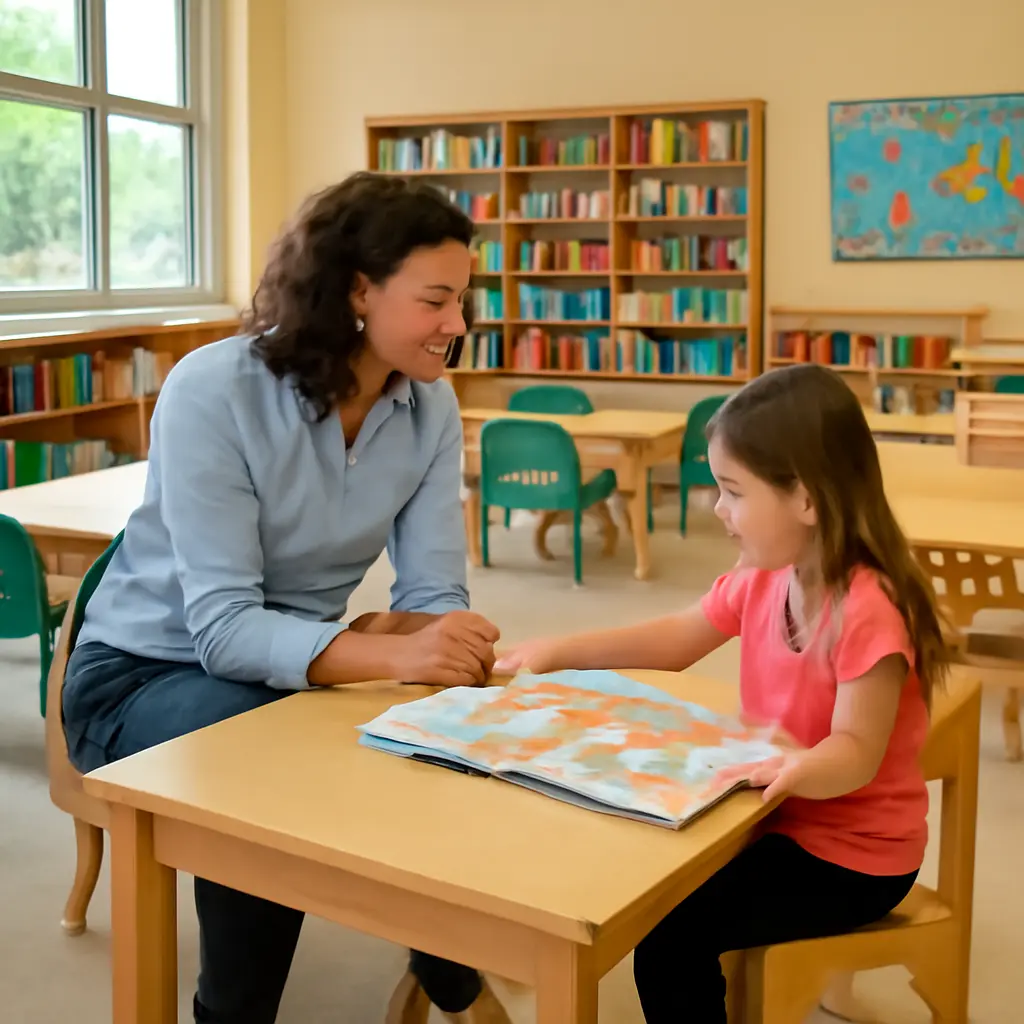
Teachers notice autism first, here’s exactly what they see

Autism is a neurodevelopmental condition involving differences in social communication and interaction, alongside restricted or repetitive behaviors, interests, or sensory experiences. Teachers may be among the first adults outside a child’s family to notice patterns that warrant attention—not because a classroom observation can diagnose autism, but because educators see children repeatedly in social, communication, learning, and sensory situations. The CDC estimates that 1 in 31 eight-year-old children in its 2022 monitoring sites was identified with autism, underscoring why it matters to recognize concerns early and connect families with qualified professionals.
What teachers notice about autism-related traits
Teachers often notice a pattern rather than one defining behavior. The American Psychiatric Association describes autism spectrum disorder through two broad areas: persistent differences in social communication and interaction, and restricted or repetitive patterns of behavior, interests, or activities. Traits vary widely, and some may be less visible in a structured classroom or in children who have learned to mask their difficulties.
A classroom is a useful setting for observation because it involves group conversation, transitions, shared activities, changing expectations, and sensory input. Those demands can reveal support needs that may not appear during a one-to-one interaction. The observations below are possible clues, not a checklist for diagnosing a child: many can also arise for reasons unrelated to autism.
Social communication and interaction
A teacher may notice that a student finds back-and-forth conversation, interpreting implied meaning, or joining peer activities unusually difficult. The child might speak at length about a favorite subject without noticing whether others want to continue, respond less often to social bids, or misunderstand jokes and indirect instructions. Some autistic children communicate fluently; others use fewer spoken words or alternative communication. Differences in eye contact alone are not a reliable indicator.
The CDC lists social-emotional reciprocity, nonverbal communication, and developing or maintaining relationships among the areas clinicians consider. In class, educators can describe the circumstances precisely—for example, whether a student participates more successfully in a structured game than in unstructured recess—rather than labeling the child as uninterested or unfriendly.
Repetition, routines, and focused interests
Another possible pattern involves repeated movements or speech, strong preferences for predictable routines, or intense interests. A student may repeat phrases, line up materials, return frequently to a particular topic, or become distressed when an expected sequence changes. These behaviors can be meaningful ways of regulating, communicating, or pursuing enjoyment; they should not automatically be treated as misbehavior.
The diagnostic framework also includes insistence on sameness and highly focused interests. Educators can note what happened before and after a change, how the student communicated distress, and which adjustments helped. That context is more useful to families and clinicians than a judgment about the behavior by itself.
Sensory responses and classroom demands
Some autistic students experience sound, light, touch, movement, taste, or other sensations differently. A child might cover their ears during assemblies, avoid certain textures, seek movement, or have difficulty concentrating in a crowded room. Sensory responses are not unique to autism, but recurring patterns can help a team understand barriers to participation.
A teacher can record the setting and practical impact: whether noise makes it hard to follow directions, whether a quieter workspace helps, or whether advance notice makes a transition easier. This turns observation into useful support planning without assuming that every sensory preference signals a diagnosis.
How classroom observations support autism identification
A teacher’s role is to notice, document, and communicate—not to diagnose. Autism identification requires a qualified evaluation that considers developmental history and behavior across contexts. The American Academy of Pediatrics recommends developmental surveillance at routine health visits and autism-specific screening at 18 and 24 months; screening indicates whether further assessment may be needed, not whether a child definitively has autism.
Teachers can add valuable information because they observe children with peers and across ordinary school routines. Their reports may help a family or evaluation team understand when traits occur, what strengths the student brings, and what supports are effective. A school-based educational evaluation and a clinical autism diagnosis are related but distinct processes; one does not automatically substitute for the other.
Document patterns rather than isolated incidents
Useful documentation is specific, neutral, and tied to context. Instead of writing “doesn’t socialize,” an educator might record that the student watched a group game, joined after an adult explained the rules, and remained engaged when the activity had predictable turns. Examples across lessons, transitions, lunch, and play can show whether a difficulty is persistent or limited to a particular situation.
- Describe what was seen or heard without assigning a diagnosis.
- Note frequency, setting, triggers, and how long the behavior lasted.
- Record strengths, interests, communication methods, and successful supports.
- Consider whether language, learning, anxiety, health, or environmental factors might also explain the observation.
Share concerns respectfully with families
A constructive conversation starts with the child’s strengths and concrete examples, then invites the family to share what they see at home. Teachers should avoid presenting autism as a conclusion or using alarming language. They can explain that observations suggest discussing development with the child’s healthcare provider and follow local school procedures for additional support.
Families may have different experiences, priorities, or access to assessment. Respectful communication means listening, protecting privacy, and avoiding assumptions about a child’s abilities or future. If a family requests help, educators can share information about appropriate school evaluation pathways and community resources, while making clear that families choose how to pursue clinical care.
Why early recognition and support matter
The CDC’s Autism and Developmental Disabilities Monitoring Network reported that 1 in 31 eight-year-olds across its 16 U.S. sites was identified with autism in 2022, compared with 1 in 36 in 2020. This is a surveillance estimate from participating communities, not a count of every child in the United States and not evidence that teachers diagnose autism. It illustrates the scale of need for informed, supportive responses in schools and healthcare settings.
Recognition can help a child access communication assistance, educational accommodations, and other supports suited to their needs. Support should not have to wait for a diagnosis when a student is struggling: educators can make reasonable classroom adjustments and use school processes to address educational needs. The goal is not to make an autistic child appear non-autistic, but to reduce barriers, support learning, and respect the child’s communication and autonomy.
A practical example: making transitions predictable
Suppose a student becomes upset when the class moves from a preferred activity to a new lesson. A teacher might first document when it happens and whether the schedule, noise, or abrupt interruption contributes. The teacher could then try a visual schedule, a brief countdown, or a clear first-then instruction and record whether the change helps. Such steps support the student now and give the family or school team concrete information; they do not establish an autism diagnosis.
Conclusion: notice carefully, support promptly
Teachers may first notice autism-related patterns in social communication, repetitive behaviors or focused interests, routines, and sensory responses. Their repeated classroom observations can help families and professionals see where a child needs support, but no single trait—or teacher’s impression—confirms autism. Record specific examples, communicate with care, and use appropriate school and healthcare pathways. For further guidance, families can speak with a pediatric healthcare professional, and educators can consult their school’s evaluation and student-support procedures.
Sources: Centers for Disease Control and Prevention, Autism Spectrum Disorder (ASD), https://www.cdc.gov/autism/about/index.html; Centers for Disease Control and Prevention, Prevalence and Early Identification of Autism Spectrum Disorder Among Children Aged 4 and 8 Years—Autism and Developmental Disabilities Monitoring Network, 16 Sites, United States, 2022, https://www.cdc.gov/mmwr/volumes/74/ss/ss7402a1.htm; American Psychiatric Association, Diagnostic and Statistical Manual of Mental Disorders, Fifth Edition, Text Revision (DSM-5-TR), https://www.psychiatry.org/psychiatrists/practice/dsm; Hyman, S. L., Levy, S. E., and Myers, S. M., Identification, Evaluation, and Management of Children With Autism Spectrum Disorder, Pediatrics, 2020, https://doi.org/10.1542/peds.2019-3447.
Related Post

Managing Daily Expectations When Your Executive Function Works Differently
Managing daily expectations when executive function works differently means planning around how a person actually [...]
Parents Ask These 5 Questions Before Scheduling Their Child’s First Assessment
A child’s first assessment is a structured conversation and evaluation that helps a qualified professional [...]