The messy reality of raising cognitively advanced but socially typical kids
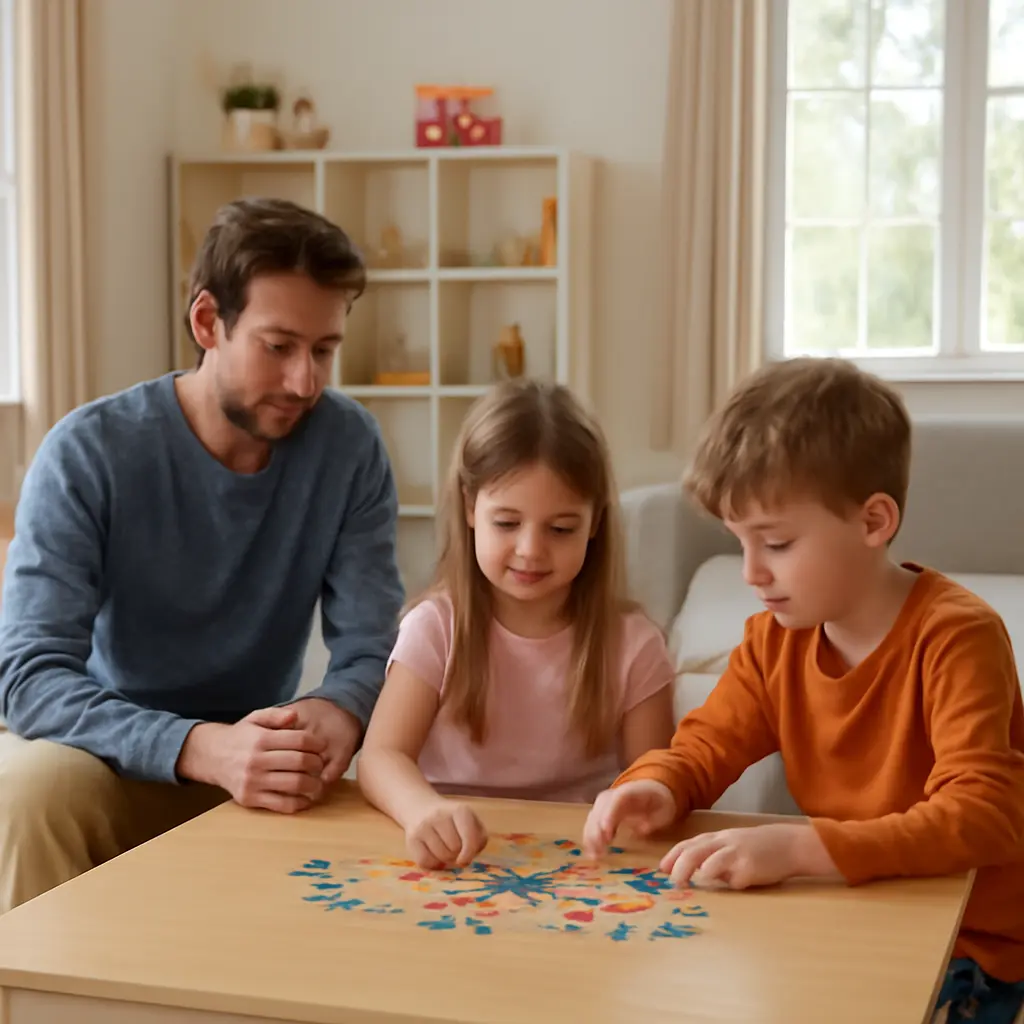
Cognitively advanced children are often described as gifted or highly able: they may learn quickly, reason deeply, or show exceptional skill in particular areas. But strong thinking skills do not automatically bring advanced social judgment, emotional regulation, or independence. Raising a child whose intellectual development runs ahead of their everyday social skills can therefore mean balancing challenge with belonging, without treating either the child’s abilities or their ordinary childhood needs as a problem. Research on gifted education, child development, and asynchronous development offers useful guidance, while also underscoring that children differ widely and that no single profile fits them all.
Understanding the cognitively advanced child’s uneven development
“Cognitively advanced” is a descriptive term, not a diagnosis. It can refer to unusually strong reasoning, memory, language, creativity, or subject-specific achievement compared with a child’s age peers. The National Association for Gifted Children (NAGC) emphasizes that giftedness can appear in different domains and communities, and that identification depends partly on the measures and opportunities available. A high test score may be informative, but it does not describe a whole child.
The everyday challenge is that development is not synchronized. A child might discuss complex scientific ideas yet need age-typical help with frustration, turn-taking, or organizing a backpack. This mismatch is often called asynchronous development. The term can help adults notice uneven needs, but it should not be used to assume that all gifted children are socially awkward or emotionally fragile.
Asynchronous development is a useful lens, not a rule
Asynchronous development describes uneven growth across domains: intellectual ability, physical skills, emotional regulation, and social experience may progress at different rates. The Columbus Group, an advocacy and educational group, popularized a definition of giftedness that highlights this mismatch and the resulting complexity of a child’s inner experience. It is best treated as a framework for asking what support a particular child needs—not as a prediction of how that child will behave.
For example, a child may understand the unfairness of a classroom rule in sophisticated terms but still react with tears when the rule is applied. That response does not cancel out the child’s reasoning ability; it reflects that insight and self-regulation are different capacities. The Center on the Developing Child at Harvard University describes executive functions—including working memory, flexible thinking, and self-control—as skills that develop over time and are shaped by experience and support.
Ability can be broad, specific, and difficult to measure
Some children show high ability across several subjects; others have a pronounced strength in one area, such as mathematics, music, reading, or spatial reasoning. A child’s performance can also be affected by language background, disability, anxiety, access to instruction, and whether an assessment captures the relevant skill. NAGC therefore recommends using multiple forms of evidence and paying attention to students who may be missed by traditional identification practices.
A single label rarely answers practical questions such as whether a child needs harder work, help with peer relationships, or support managing disappointment. Parents and educators can get more useful information by noticing patterns across settings: what the child learns quickly, where effort is needed, what situations trigger distress, and which relationships feel comfortable.
Socially typical behavior and the pressure to “act older”
Socially typical children still vary in temperament, friendship preferences, confidence, and maturity. A cognitively advanced child may enjoy age-peer friendships, prefer older companions in some activities, or move between groups depending on shared interests. These patterns are not, by themselves, evidence of a social deficit. The relevant question is whether the child can form relationships that feel safe and reciprocal, and whether everyday social demands are causing persistent distress.
Intellectual conversation does not guarantee social readiness
A child who can follow complex ideas may still be learning how to enter a game, repair a disagreement, notice another person’s cues, or cope when peers change the subject. Those are skills developed through practice and relationships, not simply through intelligence. Adults can support them without turning every awkward moment into a lesson or expecting the child to perform like an adult because of advanced vocabulary.
A practical distinction is between a skill gap and a mismatch in interests or environment. A child who dislikes a particular playground game may be making a preference-based choice; a child who repeatedly wants friends but cannot sustain interaction may benefit from gentle coaching and a closer look at what is getting in the way. Listening to the child’s own account matters more than assuming that a quiet or intense style is a problem.
Peer fit can matter more than age or test scores
Peer fit refers to whether children share enough interests, communication styles, and expectations to enjoy one another’s company. Age-based grouping can be useful, but it does not guarantee a good match. Conversely, placing a child with older peers solely because of academic ability can create social or emotional demands that exceed the child’s readiness.
Parents can widen opportunities rather than prescribe a single “right” group: clubs, sports, arts activities, library programs, and mixed-age interest groups may offer different routes to connection. The aim is not to find peers who match a child’s every ability, but to help the child experience mutual interest, acceptance, and manageable challenge.
The messy parenting work: challenge, expectations, and emotions
Raising a cognitively advanced child often involves resisting two opposite mistakes: assuming the child can manage everything independently, or treating every difficulty as proof that the child is unusually vulnerable. A better approach separates capacity from support. A child may be ready for advanced material and still need reminders, rest, emotional coaching, and ordinary boundaries.
Provide academic challenge without making achievement the child’s identity
Appropriate challenge means giving a child work that is meaningfully demanding, not simply assigning more of the same. The National Center for Education Evaluation and Regional Assistance’s 2008 evaluation of academic programs for gifted and talented students found that program effects varied, reinforcing the need to evaluate whether a particular service actually meets students’ needs rather than relying on a label alone.
Families can ask schools about subject acceleration, compacted curriculum, enrichment, flexible grouping, and opportunities to pursue independent interests. The best option depends on the child, the subject, and the school context. Praise can focus on strategies, curiosity, revision, and persistence rather than on being “the smart one,” leaving room for the child to make mistakes and learn unfamiliar skills.
Treat intense feelings as real, while teaching regulation
A child’s strong reaction may reflect disappointment, fatigue, sensory strain, perfectionism, or a mismatch between expectations and available coping skills. Adults do not need to agree with every interpretation to acknowledge the feeling: “You’re upset that the project changed; let’s work out what happens next.” Over time, routines, predictable limits, problem-solving, and opportunities to recover from small setbacks can build regulation skills.
The American Academy of Pediatrics advises that children’s emotional and behavioral concerns should be understood in context, including development, relationships, school demands, and health. If distress is persistent, interferes with daily life, or involves safety concerns, families can consult a pediatrician or qualified mental-health professional rather than assuming it is simply part of giftedness.
Protect play, rest, and age-appropriate responsibility
Advanced interests can tempt adults to fill a child’s schedule with enrichment. Yet play, sleep, movement, unstructured time, and family connection remain important. The Centers for Disease Control and Prevention recommends that children ages 6–12 get 9–12 hours of sleep per 24 hours, and adolescents ages 13–18 get 8–10 hours. These recommendations apply regardless of academic ability.
Likewise, a child’s ability to debate a topic does not mean they should carry adult responsibilities or manage every emotion alone. Age-appropriate chores, choices, and limits help children develop autonomy gradually. The goal is to offer meaningful responsibility while keeping the safety net of adult guidance.
Working with schools and noticing when more support is needed
Families and schools often see different parts of a child’s day. Collaboration works best when conversations focus on observable needs rather than competing over labels. Share examples of work that is too easy or too difficult, situations that produce stress, and conditions under which the child is engaged. Ask what the school can try, how progress will be assessed, and when the plan will be reviewed.
Use a whole-child picture when planning support
A useful plan considers academic growth, friendships, emotional well-being, disability-related needs, and the child’s own perspective. If a child has a learning disability alongside high ability, the term twice-exceptional is commonly used in education to describe the combination. Strengths can mask support needs, while difficulties can obscure advanced ability; assessment should therefore look at both rather than treating them as mutually exclusive.
Families can request a meeting with the teacher, gifted-education coordinator, school psychologist, or special-education team, depending on the concern and local procedures. Ask for specific examples and evidence, and keep a brief record of agreed actions. A plan should be revisited if the child’s engagement, stress, or progress does not improve.
Seek professional guidance for persistent impairment or risk
Not every social mismatch requires treatment. Professional guidance may be appropriate when a child experiences sustained loneliness, school refusal, severe anxiety, recurrent conflict, marked changes in sleep or mood, or difficulty functioning across settings. A pediatrician can help consider health and developmental factors and refer to specialists when needed. Describing concrete behaviors and their duration is more useful than relying on a broad label.
For example, a child who is fascinated by astronomy but has one close friend and is content may need access to shared-interest activities, not social-skills training. A child who wants friends, repeatedly feels rejected, and is distressed after school may benefit from a fuller assessment and coordinated support. These examples illustrate why the child’s experience—not a stereotype about giftedness—should guide decisions.
Conclusion: support the whole child, not just the bright parts
Cognitively advanced children can have uneven development, ordinary social needs, and very different temperaments. Asynchronous development is a helpful way to understand why strong reasoning may coexist with age-typical emotional or practical skills, but it is not a universal profile. Peer fit, suitable academic challenge, emotional coaching, sleep, play, and responsive school partnership all contribute to a child’s well-being.
Parents can start by observing where a child is thriving and where daily life feels hard, then work with the child and school on specific, reviewable supports. For further reading, consult the National Association for Gifted Children, the Center on the Developing Child at Harvard University, and the American Academy of Pediatrics. Above all, let a child be both capable and still growing.
Sources: National Association for Gifted Children, “What Is Giftedness?” and “A Definition of Giftedness,” https://nagc.org/page/what-is-giftedness; The Columbus Group, definition of giftedness, cited by the National Association for Gifted Children, https://nagc.org/page/what-is-giftedness; Center on the Developing Child at Harvard University, “Building the Brain’s ‘Air Traffic Control’ System: How Early Experiences Shape the Development of Executive Function,” https://developingchild.harvard.edu/resources/building-the-brains-air-traffic-control-system-how-early-experiences-shape-the-development-of-executive-function/; Institute of Education Sciences, National Center for Education Evaluation and Regional Assistance, “Evaluation of the U.S. Department of Education’s Student Mentoring Program,” 2008, https://ies.ed.gov/ncee/pubs/20084023/; American Academy of Pediatrics, “Mental and Behavioral Health,” https://www.healthychildren.org/English/healthy-living/emotional-wellness/Pages/default.aspx; Centers for Disease Control and Prevention, “About Sleep,” https://www.cdc.gov/sleep/about/index.html
Related Post
What Teachers Wish Parents Knew About Language Development in Young Learners
Language development is the way young children learn to understand and use sounds, words, sentences, [...]
Parents Ask These 5 Questions Before Scheduling Their Child’s First Assessment
A child’s first assessment is a structured conversation and evaluation that helps a qualified professional [...]